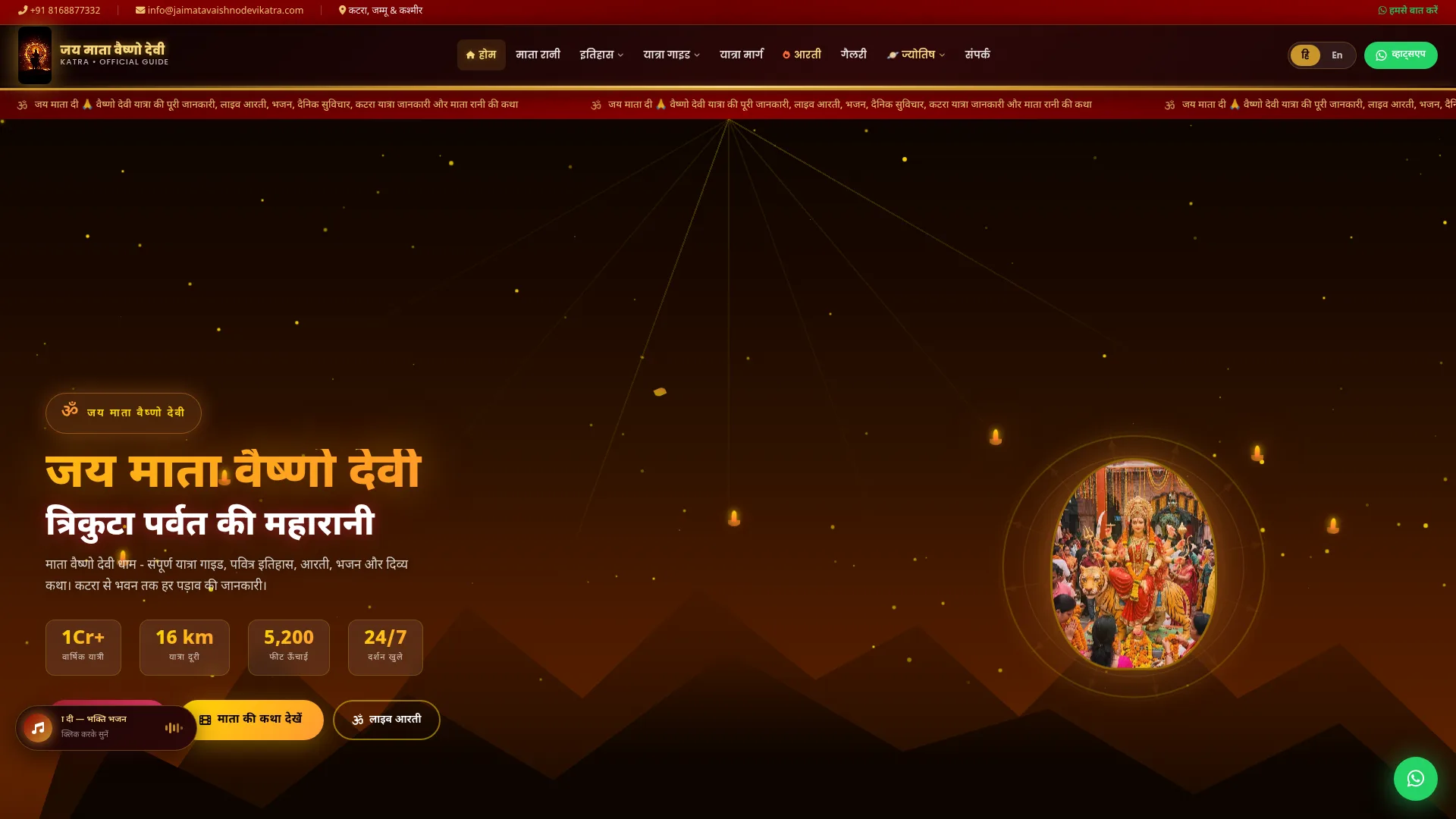
Vaishno Devi Katra
A published website from BuntyTech. Use it as a visual reference only; its audience and requirements differ from those of every small business.

A useful business website answers three questions quickly: what the company does, who it serves and how a customer can take the next step. BuntyTech builds business websites remotely for Indian companies that need a clear online presence rather than a collection of decorative pages.
Before choosing colours or animations, map what a first-time visitor needs to learn. A service business may need a focused home page, service details, company information, project evidence and a contact route. A product business may need a catalogue or store instead. Give each page a purpose and avoid adding pages simply to make the site appear larger.
The five-page offer is suitable only when its page count and agreed scope fit the business. It does not automatically define copywriting, professional photography, advanced booking, payment gateways or recurring support. Put those requirements on the estimate so the business owner can compare the real deliverable rather than just the headline number.
Add an admin panel when staff need to update records through a secure interface, not just because the term sounds useful. A catalogue, booking flow or customer portal adds different permissions and testing needs. If the website must accept orders, use the ecommerce scope instead of treating an online store as a simple contact form.
A business website should help a visitor understand the offer, decide whether it fits and take the next step. A homepage alone rarely answers every practical question. Service details, proof that can be verified, location or service coverage, pricing guidance and a clear contact route each have a job. The exact page set depends on the business; a small company should not copy a large enterprise sitemap just to appear established.
Before development, gather the business name, services, service area, current contact details, approved photographs and real examples customers can review. Name who approves the copy and keep service claims current. When pricing depends on a custom scope, show visitors how to request an estimate instead of displaying a number that does not fit the work. These decisions give a small business website designer the information needed to build a coherent site.
These BuntyTech portfolio pages show real examples of published work. They are included for design and content review, not as claims about traffic, rankings or sales results.
A published website from BuntyTech. Use it as a visual reference only; its audience and requirements differ from those of every small business.
BuntyTech confirms ₹4,999 for a five-page website and ₹9,999 for a complete website with an admin panel. The quote must define which pages and admin functions are included. For a landing page or ecommerce store, use the corresponding offer and confirm any outside fees separately.
For Business website development, ask the written quote to spell out inclusions, exclusions, content ownership, third-party charges, payment milestones and handover. BuntyTech’s standard website prices are in the website cost guide.
The page names and content depend on the business. A common starting structure is home, company information, services, a proof or portfolio page and contact. Confirm the final five pages and any extra functionality before approving the quote.
BuntyTech confirms ₹4,999 for a five-page website. The offer does not by itself confirm every possible feature or third-party cost; ask for the written scope and exclusions.
BuntyTech can work remotely with businesses across India. Location pages describe service coverage, not a claim of a local office or in-person presence in every city.
Most small businesses need a clear home page, service or product information, contact details and a direct enquiry path. Additional pages should answer real customer questions rather than repeat the same sales copy.
BuntyTech lists a five-page website at ₹4,999. Ask for the exact page list, content responsibilities, design scope and any third-party costs before approving the project.
A website gives the business a place to organise its own pages and contact routes. Social profiles can support discovery, but they do not replace a clear, independently accessible source of business information.
Often, but future additions depend on the platform and scope. Ask how pages are updated, whether the team receives a handover, and how later change requests are estimated.
The written quote should name who supplies or creates each item and who approves it. Use only images and testimonials the business has permission to publish.
Mobile layout should be included as a stated deliverable and tested at common screen sizes. Confirm that forms, navigation, text and contact buttons remain usable on a phone.
A useful scope can cover crawlable page content, distinct titles and descriptions, a logical heading structure, canonical URLs, internal links and mobile usability. These foundations support discovery but do not guarantee indexing or rankings.
Share the project type, budget range and preferred timeline. We can review the scope and clarify deliverables before you decide whether to proceed.